

Google Ads can generate valuable leads, but a higher advertising budget cannot fix a campaign with weak targeting. If irrelevant searches, unsuitable locations, or poorly matched landing pages consume your spend, adding more money may increase the waste.
For businesses running Google Ads in Oman, campaign quality should come before campaign scale. Reviewing keywords, Search Terms, location settings, landing pages, network options, and conversion data can reveal problems that are often more important than budget size.

Why Google Ads Budget Can Be Wasted
Advertising spend becomes inefficient when the campaign attracts users who have little chance of becoming customers. A click may look positive inside a campaign report, but it provides limited business value when the visitor has the wrong intent, location, or expectations.
The goal should therefore be more specific than increasing traffic. Businesses should focus on attracting relevant searches, connecting those searches with suitable ads, and directing visitors toward pages that can realistically turn interest into qualified leads.
1. Using Broad Match Without Enough Control
Broad Match allows advertisers to reach searches related to their chosen keywords without requiring users to type the exact phrase. This gives Google more flexibility to identify relevant queries and can help campaigns discover search demand that advertisers may not have considered manually.
That flexibility is useful, but it also reduces direct control over which searches may trigger an advertisement. Broad Match should therefore be managed alongside reliable conversion tracking, campaign data, Search Terms analysis, and bidding strategies rather than treated as a simple way to increase traffic.
How Broad Match Can Attract the Wrong Search Intent
A company targeting a broad phrase related to digital marketing may receive searches from people looking for jobs, courses, free tools, templates, or general information. These searches may be closely related to the keyword while having almost no commercial relevance to the service being advertised.
This distinction between keyword relevance and business intent is important. A search may seem related but still be unsuitable for the campaign. Advertisers should assess whether Broad Match queries target potential customers, not just based on wording.
When Phrase and Exact Match Can Offer More Control
Phrase and Exact Match can be useful when an advertiser wants tighter control around high-value commercial searches. For specific services, a more focused keyword structure may help ensure that ads appear for queries that closely reflect what the business actually offers.
Not every campaign should replace Broad Match; different match types serve various purposes. The best choice depends on campaign maturity, conversion data, search volume, bidding strategy, service type, and review ability.
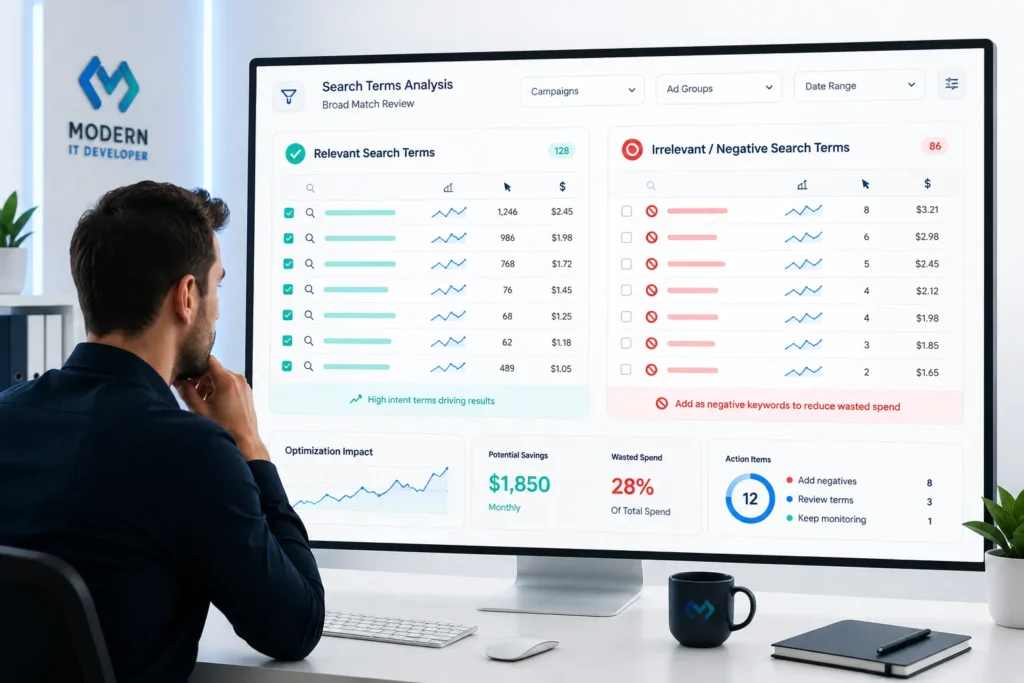
2. Ignoring the Search Terms Report
Keywords tell Google which searches you want to target, while the Search Terms report helps show which actual searches triggered your advertisements. This distinction makes Search Terms analysis one of the most useful ways to understand what is happening behind campaign clicks.
Advertisers should review these searches for patterns rather than looking only at individual queries. Repeated themes can reveal new keyword opportunities, unexpected customer language, irrelevant traffic, or areas where the existing keyword strategy is too broad.
Why Search Terms Matter for Google Ads Optimization
A campaign may get many clicks but still attract weak traffic. Checking Search Terms shows if those clicks are from potential customers or people looking for info, jobs, training, free resources, or unrelated services.
This information also improves future optimization decisions. Instead of assuming what customers search for, businesses can use real query data to refine keywords, improve ad messaging, adjust landing pages, and identify search patterns worth excluding.
3. Not Building a Useful Negative Keyword List
Negative keywords help prevent advertisements from appearing for searches that do not fit the campaign objective. A professional service business, for example, might consider excluding terms associated with employment, internships, free downloads, or training when those searches repeatedly generate irrelevant clicks.
The correct negative keywords depend on the business. A term such as “course” could be irrelevant for a web development company but highly valuable for a training provider. Negative keyword decisions should therefore come from search intent and actual campaign performance rather than generic keyword lists.
Avoid Being Too Aggressive With Negative Keywords
Adding too many exclusions can create a different problem. A negative keyword that seems irrelevant at first may also appear in valuable searches, causing the campaign to lose potential customers if exclusions are applied without enough context.
Treat negative keyword management as an ongoing process. Advertisers should review new Search Terms, identify recurring irrelevant themes, apply exclusions, and continue monitoring performance rather than creating a large negative list and neglecting it.
4. Choosing the Wrong Location Targeting
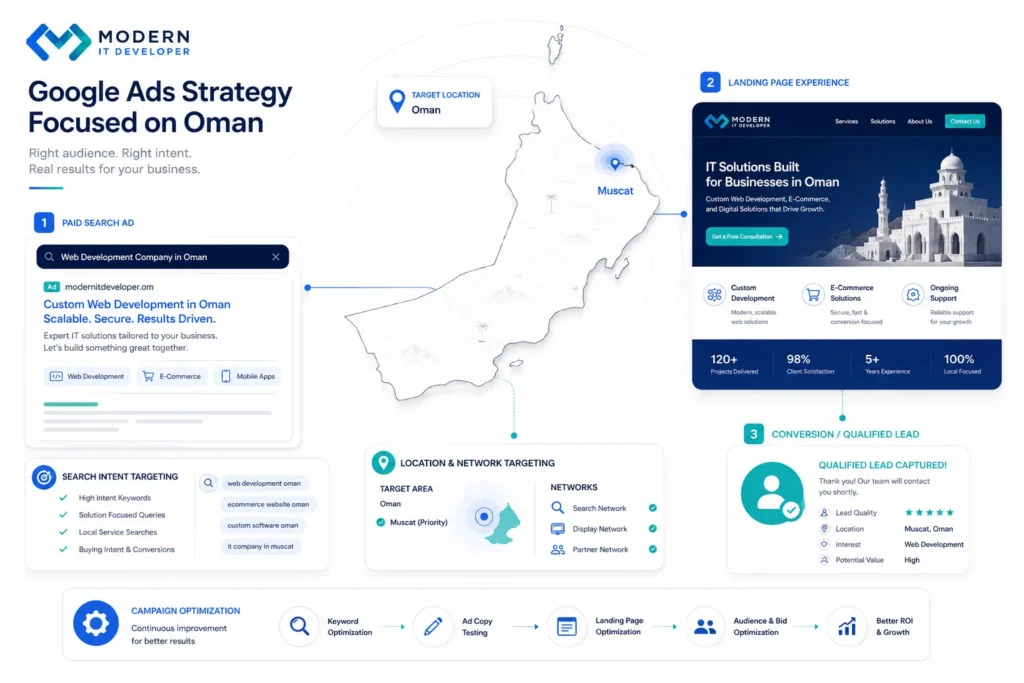
Location targeting is particularly important for companies running Google Ads in Oman. A business may want to reach the entire country, concentrate on Muscat, target several specific cities, or restrict advertising to areas where its team can realistically provide services.
Selecting a location does not automatically mean every person who sees an advertisement will perfectly match the intended geographic audience. Location targeting relies on several signals, which makes reviewing geographic campaign data important after the campaign begins generating traffic.
Presence and Location Interest Are Not the Same
Some location settings can reach people physically present in a target area, while broader settings may also include users who have demonstrated interest in that location. The best option depends heavily on what the company sells and how customers normally purchase it.
A home service provider operating only in Muscat may prefer a stronger focus on people physically located nearby. A tourism company could benefit from reaching users outside Oman who are actively researching Muscat because their future travel plans create genuine commercial intent.
Match Geographic Targeting to Your Service Area
Campaign geography should reflect the actual areas a company can serve profitably. Advertising throughout Oman may create unnecessary spend when a business operates primarily in Muscat and cannot effectively respond to leads from distant locations.
Advertisers can compare clicks, conversions, lead quality, and customer locations to identify where useful demand originates. Location exclusions and regional campaign adjustments may then help concentrate the advertising budget on areas that consistently produce stronger business opportunities.
5. Sending Visitors to the Wrong Landing Page
A relevant search and a strong advertisement can still fail when visitors reach the wrong page. The landing page should continue the promise made by the ad and give users clear information about the specific product, service, or solution they searched for.
Sending every campaign to a general homepage can create unnecessary friction. Visitors may have to search through multiple services before finding what they need, increasing the chance that they leave before taking a meaningful action.
Search Intent Should Continue Onto the Landing Page
Consider someone searching for “technical SEO audit Muscat.” That person is expressing a much more specific need than someone searching simply for “digital marketing company.” Both searches should not automatically lead to exactly the same experience.
A dedicated technical SEO page can directly explain the audit process, relevant problems, expected deliverables, and the next action. This creates a clearer journey from search query to advertisement, landing page, and conversion opportunity.
Make the Conversion Action Easy to Understand
Landing pages should also make the next step obvious. Depending on the campaign, that action might involve requesting a quote, booking a consultation, submitting a form, calling the company, or asking for more information.
Too many competing actions can make the page harder to navigate. A focused landing page usually benefits from one primary conversion objective supported by relevant information, trust signals, useful service details, and a clear reason for visitors to continue.
6. Accepting Network Settings Without Reviewing Them
Search campaigns can sometimes extend beyond the primary Google Search environment through additional network options. These settings may increase campaign reach, but more reach does not automatically mean better traffic or stronger lead quality.
Advertisers should understand which networks are active and compare the resulting traffic with campaign objectives. The important question is not whether a network is universally good or bad, but whether it contributes valuable results for that specific business.
Evaluate Search Partner Performance
Search Partners can expose advertisements to additional search environments outside the main Google Search results. This can create extra opportunities to reach potential customers and may provide useful conversions for some advertisers.
However, performance should still be monitored. Businesses should evaluate conversion quality and overall campaign outcomes rather than assuming that every additional source of clicks deserves the same budget priority as traffic coming directly from Google Search.
Review Display Expansion Separately
Search and Display advertising usually reach people in different situations. A user actively searching for a service is demonstrating immediate intent, while someone browsing content on another website may not currently be looking to make a purchase.
When Display Expansion or similar reach settings are enabled, advertisers should understand how that additional traffic contributes to the campaign. Mixing different intent levels without reviewing performance can make campaign reports harder to interpret and budget decisions less precise.
7. Measuring Clicks Instead of Qualified Leads
Clicks and impressions are useful advertising metrics, but they do not reveal whether a campaign is generating valuable business opportunities. A campaign can produce high traffic while delivering leads that are irrelevant, unqualified, or unlikely to become customers.
Businesses should connect advertising metrics with meaningful actions such as completed forms, phone calls, bookings, quote requests, purchases, or other conversions. The most useful conversion events depend on the company’s sales process and campaign objectives.
Lead Quality Matters More Than Conversion Volume
Not every recorded conversion carries the same business value. Ten poor-quality inquiries can create more work and less revenue than three highly relevant leads from people who genuinely need the advertised service.
Campaign analysis should therefore include what happens after the conversion. Sales feedback, customer location, service interest, lead value, and eventual outcomes can provide a much clearer picture of whether Google Ads is reaching the right audience.
What to Review Before Increasing Your Google Ads Budget
Before increasing spending, advertisers should examine whether the current budget is reaching suitable users. Search Terms, keyword match types, negative keywords, geographic targeting, network settings, landing pages, conversion tracking, and lead quality all deserve attention.
This review can reveal whether budget limitations are genuinely preventing growth or whether the campaign first needs optimization. Increasing spend is more reasonable when existing traffic is already relevant and additional demand can be captured without significantly reducing lead quality.
How Dune Seed Approaches Google Ads Optimization
At Dune Seed, paid advertising is considered part of a broader digital marketing system rather than an isolated source of clicks. Search intent, campaign structure, landing-page experience, website performance, conversion tracking, and lead quality all influence advertising effectiveness.
For businesses operating in Oman, this connected approach can make campaign decisions more practical. Instead of focusing only on bids or daily spend, companies can examine the entire customer journey and identify where advertising traffic is being lost or becoming less relevant.
Fix Campaign Quality Before Scaling the Budget
A larger Google Ads budget works best when the campaign already has a strong foundation. If irrelevant traffic, weak targeting, unsuitable landing pages, or unclear conversion data remain unresolved, additional spending may simply increase the scale of the same problems.
Start by improving relevance at every stage: search query, keyword, targeting, advertisement, landing page, and conversion. Once the campaign consistently attracts the right audience and produces useful business outcomes, decisions about increasing the budget become much easier to justify.
Frequently Asked Questions
Why Is My Google Ads Campaign Getting Irrelevant Searches?
Irrelevant searches can appear when keywords cover a wider range of intent than expected, particularly when broader matching is used. Some queries may be related to the keyword while still being unsuitable for the business.
Reviewing the Search Terms report can reveal these patterns. Advertisers can then refine their keyword strategy, add appropriate negative keywords, or adjust campaign structure based on the types of searches actually generating traffic.
Should I Stop Using Broad Match Keywords?
Broad Match does not need to be removed from every campaign. It can help advertisers discover relevant searches that would be difficult to predict manually, particularly when campaigns have useful conversion data and suitable bidding strategies.
The important factor is control. Advertisers should monitor Search Terms, lead quality, conversion performance, and irrelevant traffic so that broader reach contributes to business goals instead of simply generating additional clicks.
How Often Should I Review Google Ads Search Terms?
New campaigns generally benefit from closer monitoring because advertisers are still learning how Google is matching keywords with real searches. Campaigns with rapidly changing products, services, or search behavior may also require frequent reviews.
More established campaigns may not need the same level of attention every day. The appropriate schedule is the one that identifies irrelevant patterns before they consume meaningful advertising budget.
Should Google Search Partners Be Disabled?
Search Partners should not automatically be disabled simply because they extend reach beyond the primary Google Search results. They can generate valuable traffic and conversions for some campaigns.
Performance should determine the decision. Compare conversion quality and business outcomes from different network sources, then decide whether Search Partners support the campaign objective or whether the budget would be better concentrated elsewhere.
Can Better Google Ads Targeting Guarantee More Conversions?
No targeting strategy can guarantee conversions. Better targeting can increase the likelihood that advertisements reach people with more relevant locations, interests, and search intent, but many additional factors influence whether those users become customers.
The offer, pricing, landing-page experience, website quality, competition, trust, sales process, and market demand all contribute to conversion performance. Google Ads optimization should therefore be connected with the wider marketing and sales strategy.