
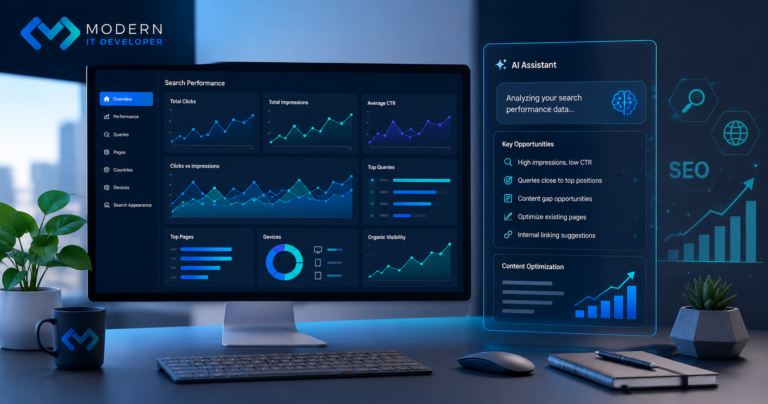
Improving organic visibility does not always require a new blog post. Sometimes the best opportunity is already on your website: an existing article that Google shows for useful search queries but that does not fully answer them yet.
The method DuneSeed suggests uses Google Search Console data and AI-assisted analysis to identify missed opportunities. Instead of guessing what readers want, you use real impressions, clicks, and ranking positions to guide a targeted content update.
This approach can help you improve SEO faster and get more value from content you have already created.
Why Existing Content Is an SEO Opportunity
An indexed article already has a history with Google. It may have backlinks, internal links, impressions, and rankings for keywords that were never intentionally targeted.
Over time, however, the article may become incomplete. New questions appear, competitors publish more detailed information, and users begin searching with different phrases.
A structured article/blog review helps you discover:
- Queries generating impressions but few clicks
- Keywords ranking close to the first page
- Relevant topics mentioned only briefly
- Missing subtopics users are actively searching for
- Sections that need clearer headings or explanations
Rather than replacing the article, you can improve it while keeping its original URL and purpose.
Step 1: Find the Article in Google Search Console
Open Google Search Console, select the correct website property, and go to the Performance report.
Choose a Useful Date Range
A three-month period is usually long enough to reveal meaningful patterns.
Review:
- Clicks
- Impressions
- Click-through rate
- Average position
Open the Pages tab and select the article you want to improve. Once the page filter is active, return to Queries. You will now see the searches connected specifically to that page.
Look Beyond the Main Keyword
Do not focus only on the keyword you originally chose. Search Console often reveals related terms that show how Google currently understands the article.
Prioritize queries that:
- Are clearly relevant
- Have meaningful impressions
- Rank between positions 8 and 30
- Represent a question not fully answered
- Share a topic with several similar queries
These are often strong candidates for a content update.
Step 2: Export and Organize the Query Data
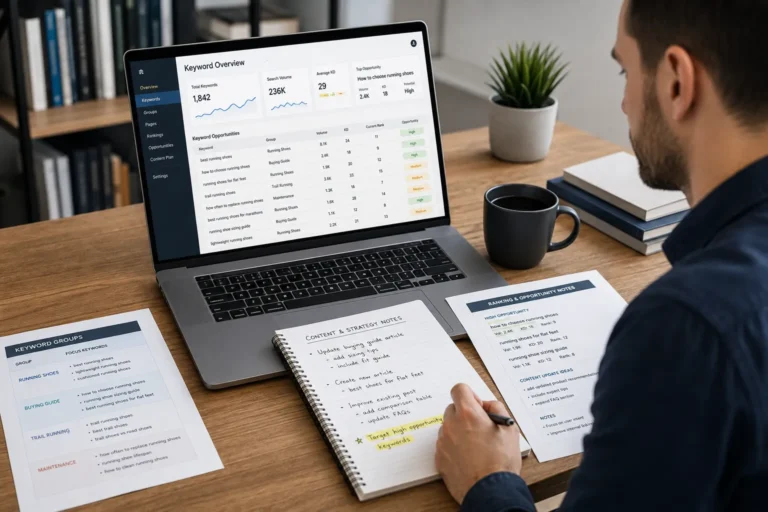
Use the Export option in Search Console to download results to Google Sheets, Excel, or CSV. This makes it easier to compare queries, impressions, clicks, and positions.
Remove obviously irrelevant searches before continuing. A page can appear for unrelated terms, so not every query warrants a new section.
Your goal is not to force every keyword into the article. It is to identify groups of searches that align with the page’s main subject and search intent.
Step 3: Compare the Queries With the Existing Article
Copy the current article and provide it, along with the exported Search Console data, to an AI tool. Ask the tool to compare the two rather than generate a completely new post.
What the AI Analysis Should Identify
A useful prompt should request:
- Relevant keyword clusters with meaningful impressions
- Topics that are missing or only partially covered
- Queries with different search intent that should be excluded
- Duplicate or overlapping keywords
- Opportunities ranked by relevance, impressions, and position
- Suggested H2 sections and useful H3 subsections
- Existing sections that should be expanded, renamed, or merged
This makes AI a research and editing assistant instead of an uncontrolled content generator.
Step 4: Update the Article Without Changing Its Core Intent
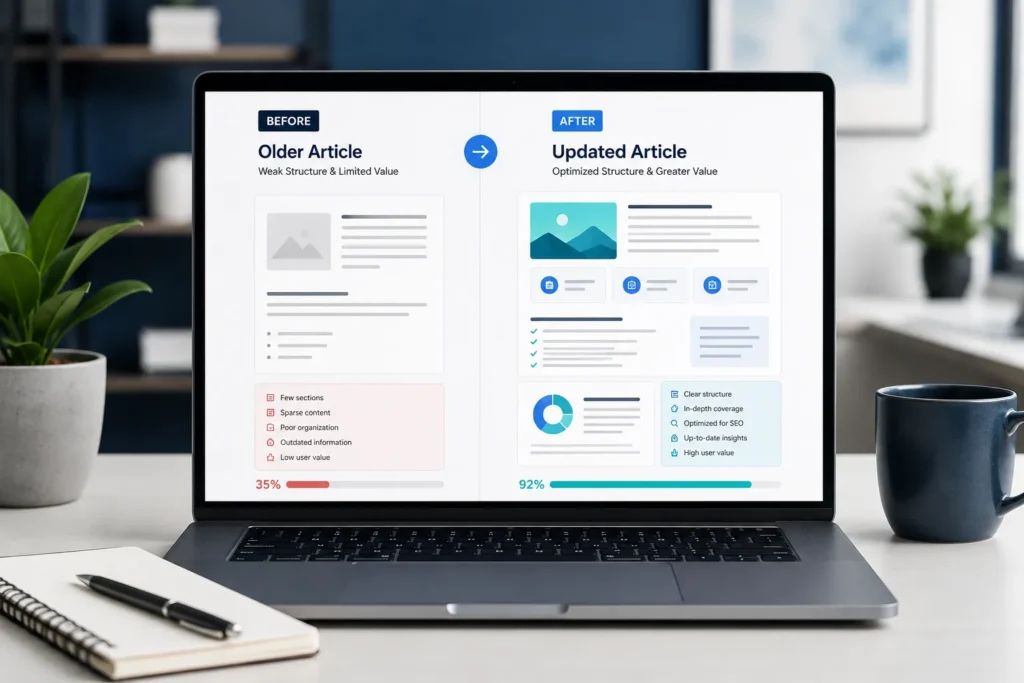
Once the opportunities are clear, improve the article carefully. The goal is to make it more complete, not turn it into a different page.
Expand the Right Sections
Add concise answers, practical examples, comparisons, or definitions where the data shows genuine demand. A strong update may include:
- A new H2 for an important keyword cluster
- H3 headings for related questions
- A short FAQ section
- Updated screenshots or instructions
- Stronger internal links
- More descriptive image alt text
Each addition should help the reader. Avoid adding paragraphs only to increase word count or repeat keywords.
Preserve What Is Already Working
Do not change the URL unless there is a strong technical reason. Avoid deleting useful sections without checking whether they already rank for valuable searches.
Keep the primary search intent stable and use secondary keywords naturally. Keyword stuffing reduces readability and can weaken an otherwise helpful update.
Step 5: Review On-Page SEO
A content update is also a good time to check:
- SEO title and meta description
- H1, H2, and H3 structure
- Internal and external links
- Broken links
- Image size and alt text
- Mobile readability
- Outdated facts or screenshots
- Calls to action
A better title and meta description may improve click-through rate, while clearer headings improve understanding.
Step 6: Publish and Measure the Results
After updating the article, record the date and the main changes. You may request indexing through Google Search Console, but avoid submitting the same URL repeatedly.
Monitor the page over the following weeks. Compare clicks, impressions, average position, and the number of queries gaining visibility. SEO results are rarely immediate, but a well-targeted update can gradually expand the page’s reach.
Common Mistakes to Avoid
- Changing only the publication date
- Adding every exported query
- Creating sections unrelated to the original intent
- Rewriting a ranking page from scratch
- Publishing unchecked AI output
- Ignoring performance after the update
Real search data should guide the strategy, but human review remains essential.
Want the Exact SEO Content Update Prompt?
We’ve prepared the exact prompt we use to analyze existing content, find keyword opportunities, identify missing topics, and plan effective SEO updates. If you’d like a copy, leave your email address or phone number in the comments, and our team will send the prompt directly to you. If you prefer not to share your contact details publicly, you can also contact the Modern IT Developers team through duneseed.com.
Frequently Asked Questions
How often should existing website content be updated for SEO?
Content should typically be reviewed every six to twelve months. Articles on fast-changing topics such as SEO, technology, software, and digital marketing may need updates every three to six months. The best time to update a page is when its traffic declines, the information becomes outdated, or new search queries appear in Google Search Console.
Can updating an old article improve its Google rankings?
Yes. Updating an existing article can improve its rankings when the changes make the content more accurate, relevant, complete, and useful. Adding missing information, improving headings, updating links, optimizing keywords, and matching current search intent can help Google reassess the page positively.
How can Google Search Console help identify opportunities to update content?
Google Search Console displays the queries that lead to impressions and clicks for each page. You can analyze this data to find relevant keywords with high impressions, low click-through rates, or rankings close to the first page. These queries often indicate missing sections or questions that should be incorporated into the article.
Should the URL of an existing article be changed during an SEO update?
In most situations, the answer is no. Modifying the URL can result in losing the page’s ranking history, backlinks, and current authority. It is best to retain the existing URL whenever possible. If a URL change is unavoidable, ensure to implement a proper 301 redirect from the old URL to the new one.
Final Thoughts
You do not always need a new article to boost SEO. Google Search Console can show where an existing page has higher ranking potential, while AI can assist in organizing data and spotting content gaps.
At Modern IT Developers, we leverage this data-driven approach to transform underperforming pages into stronger organic assets. Visit duneseed.com for effective SEO, content enhancement, and website growth strategies.