
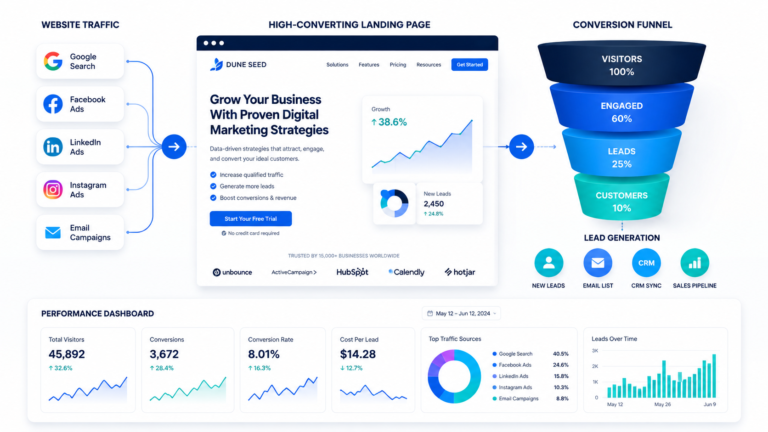
Why Your Ads Bring Visitors but Not Enough Leads
Many businesses invest heavily in paid advertising campaigns to attract potential customers, but the final results often do not match expectations. Clicks increase, website traffic grows, and advertising costs continue — yet the number of qualified leads remains lower than expected.
In many cases, the problem is not the advertising campaign itself. The real issue is what happens after users click the ad and arrive on the landing page. A landing page with unclear messaging, confusing navigation, weak trust signals, or unnecessary steps can prevent interested visitors from taking action.
Landing page conversion optimization focuses on removing these barriers and creating a smoother path from visitor interest to customer action. Instead of spending more money to attract additional traffic, businesses can improve the performance of the traffic they already have.
What Is Landing Page Conversion Optimization?
Landing page conversion optimization is the process of improving a dedicated webpage so that a higher percentage of visitors complete a desired action.
This action can be different depending on the business goal:
- Booking a consultation
- Requesting a quote
- Completing a purchase
- Signing up for a service
- Downloading a resource
- Contacting the business
The goal is not simply to make a page look better. A successful landing page reduces hesitation, answers visitor questions, builds confidence, and guides users toward one clear decision.
Why Good Advertising Traffic Still Fails to Convert
Paid traffic usually means visitors already have some level of interest. They searched for a solution, clicked an advertisement, or responded to a marketing message.
However, interest does not automatically create conversions.
Visitors leave when they encounter friction during their decision-making process.
Common conversion blockers include:
- Unclear next steps
- Too many choices
- Long forms
- Slow loading pages
- Poor mobile experience
- Missing reviews or proof
- Weak explanation of benefits
A visitor may be ready to contact a company, but even small obstacles can create doubt and cause them to leave.
The Most Common Landing Page Friction Points
Conversion friction refers to anything that makes completing an action more difficult than necessary.
Small problems can have a significant impact because users make decisions quickly, especially when browsing on mobile devices.
| Friction Point | Why It Hurts Conversion | Recommended Solution |
|---|---|---|
| Unclear CTA | Visitors do not know what action to take next | Use one clear and specific CTA such as “Book a Free Consultation” |
| Long Contact Forms | Users may abandon the process before completion | Remove unnecessary fields and request only essential information |
| Poor Mobile Experience | Users struggle with navigation and interaction | Optimize layouts, buttons, and loading speed for mobile devices |
| Lack of Trust Signals | Visitors hesitate because they cannot verify credibility | Add reviews, testimonials, certifications, and case studies |
| Too Many Choices | Decision fatigue reduces action | Create one primary conversion path |
Create One Clear Conversion Path
One of the biggest mistakes businesses make is trying to communicate everything on a landing page.
A visitor should immediately understand:
- What problem you solve
- Who your service is for
- Why they should trust you
- What they should do next
A landing page should not force visitors to compare multiple options, search through menus, or decide between several competing actions.
A focused page usually performs better because it removes unnecessary decisions.
Improve Your Call-to-Action Strategy
The CTA is one of the most important elements on any landing page because it directly influences user behavior.
A weak CTA creates uncertainty.
A stronger CTA communicates the next step:
- Get Your Free Website Audit
- Book a Marketing Consultation
- Request Your Custom Quote
- Start Your Free Trial
The best CTA is specific, visible, and connected to the visitor’s goal.
Reduce Form Friction Without Losing Quality Leads
Many businesses collect too much information too early.
A better approach is to collect information progressively.
Start with essential details:
- Name
- Email or phone number
- Short message
After the first interaction, you can collect additional information through follow-up conversations.
The objective is to reduce barriers while maintaining lead quality.
Optimize Mobile Experience for Better Conversions
A large percentage of website visitors now browse from mobile devices. This means a landing page that works well on desktop but creates difficulties on smartphones can lose valuable leads.
A mobile visitor should be able to understand the offer and complete the desired action without unnecessary effort.
Improving mobile experience does not always require a complete redesign. Sometimes small adjustments such as simplifying layouts, improving speed, and making CTAs easier to access can create noticeable improvements.
Build Trust Before Asking Visitors to Take Action
Even when users are interested in a service, they still need confidence before sharing their information or making a purchase decision.
Trust signals reduce uncertainty by showing visitors that a business is reliable.
Dune Seed approaches digital growth by combining technical improvements, user experience, and strategic marketing decisions instead of focusing on only one part of the customer journey.
Improve Conversion Without Increasing Ad Spend
| Scenario | Monthly Visitors | Conversion Rate | Generated Leads |
|---|---|---|---|
| Before Optimization | 10,000 | 1% | 100 Leads |
| After Optimization | 10,000 | 2.5% | 250 Leads |
The traffic volume stays the same, but better conversion performance creates significantly more opportunities.
This is why improving landing page performance is often a more efficient strategy than simply increasing marketing spend.
Practical Steps to Optimize Your Landing Page
Businesses can begin improving conversions by following a structured process.
1. Analyze Visitor Behavior
Use analytics tools to understand:
- Where visitors leave
- Which sections receive attention
- How users move through the page
- Whether mobile users behave differently
Tools such as Google Analytics and heatmap platforms can reveal areas that require improvement.
2. Review Your Main Message
The first section of your landing page should immediately answer:
- What do you offer?
- Who is it for?
- Why should visitors choose you?
If users need to scroll or search to understand your value, many will leave before reaching your CTA.
3. Simplify the Conversion Process
Remove unnecessary steps between interest and action.
Review:
- Number of form fields
- Number of buttons
- Required information
- Navigation options
Every additional step creates another opportunity for abandonment.
4. Add Relevant Proof
Use evidence that supports your claims.
Examples:
- Before-and-after results
- Customer feedback
- Project examples
- Industry recognition
Trust should appear close to important conversion points, especially near forms and CTAs.
Common Landing Page Optimization Mistakes
Even experienced businesses can make mistakes that reduce conversions.
Focusing Only on Design
A visually attractive page does not automatically generate leads.
Good design should support:
- Clear communication
- Easy navigation
- Strong user decisions
A beautiful page with confusing messaging can still perform poorly.
Adding Too Many Conversion Options
Multiple CTAs may seem helpful, but they can create confusion.
Visitors should have a clear next step instead of choosing between many different actions.
Ignoring Existing Traffic Data
Businesses often redesign pages based on assumptions instead of user behavior.
Before making changes, review:
- Analytics data
- Conversion rates
- User feedback
- Search intent
Data-driven improvements usually produce better decisions.
The Future of Conversion Optimization
Conversion optimization is becoming increasingly connected with personalization, artificial intelligence, and user experience analysis.
Modern businesses are using technology to better understand visitor behavior and create more relevant experiences.
A successful landing page is not about forcing visitors to convert. It is about making the decision easier for people who already have interest.