


Increasing organic traffic doesn’t necessarily mean publishing more articles. Opportunities are often hidden in Google Search Console, such as pages with impressions, queries just outside top positions, and content gaining visibility without clicks.
Dune Seed provides a tutorial on using Search Console data with Claude AI to help spot these opportunities. Search Console offers real performance data, while Claude organizes, clusters, compares, and interprets it. Search Console exports data in CSV, Excel, and Google Sheets, which Claude can analyze. The main point is to use AI as an analytical tool, not as a guarantee of first-page rankings.
Why Google Search Console Is Valuable for SEO Analysis
Google Search Console shows website metrics such as queries, pages, and clicks, helping identify content related to Google Search. It raises questions like which queries have many impressions but few clicks, which pages rank for related topics, which could improve titles/descriptions, if pages compete for similar search intent, and which topics need more content.
How to Use Claude AI for SEO with Search Console Data
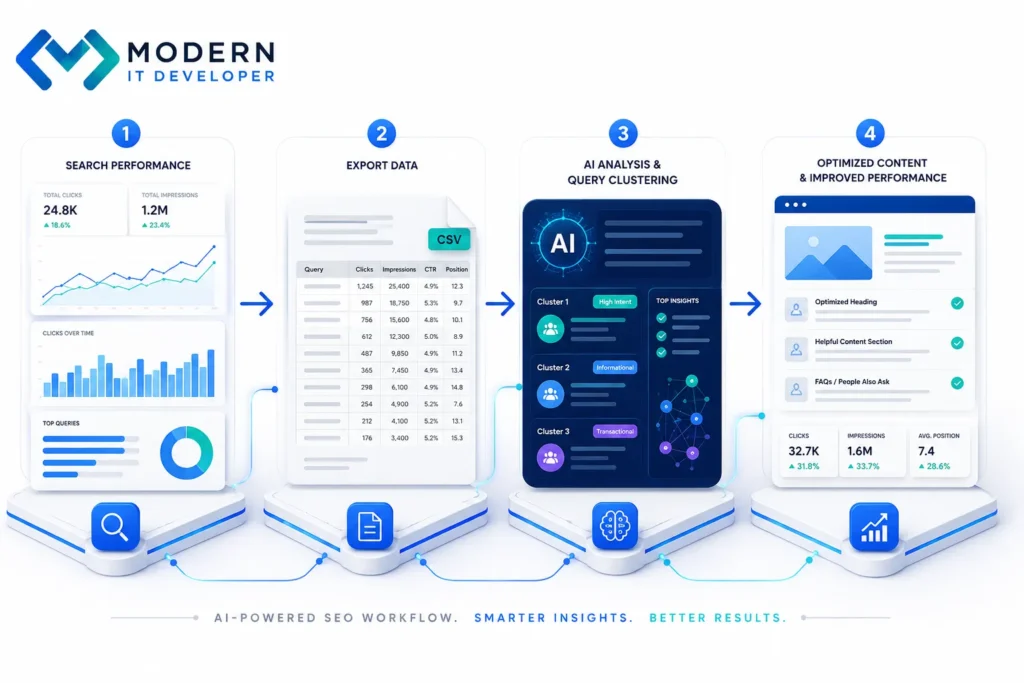
1. Export Your Search Performance Data
Open Google Search Console’s Performance section and select a useful date range, ideally several months for thorough analysis. You can compare different ranges. Export data to Google Sheets, Excel, or CSV. Key columns include:
- Query
- Page
- Clicks
- Impressions
- CTR
- Position
2. Upload the Data to Claude
Claude supports CSV documents, making exported Search Console files suitable for analysis directly inside the AI assistant.
Do not simply ask: “How can I improve my SEO?” Give Claude a specific analytical task.
That prompt gives the model a much clearer job.
3. Look for Queries That Are Already Close to Stronger Visibility
One useful category is queries in which a page already appears frequently but has room for improvement.
For example, imagine a page receives impressions for:
- technical SEO audit checklist
- website SEO audit
- SEO audit for small business
- technical website analysis
If the article only covers general SEO audits, these queries may uncover missing sections users seek. Updating the page may be better than creating four similar articles.
Avoid treating average position as an exact ranking; Google defines it as the average position of the top result and recommends not focusing too much on it. Trends in clicks and impressions are often more meaningful.
Find High-Impression, Low-CTR Opportunities
Analyzing queries with many impressions but few clicks can be useful but doesn’t necessarily indicate a problem.
- CTR varies due to ranking position
- Search intent
- Branded vs. non-branded searches
- SERP features
- Title relevance
- Meta description quality
Google uses clicks and CTR to gauge search volume and effectiveness. Claude can group queries and highlight patterns, but humans should review results before changes. A low CTR may mean the title misleads or Google already answers the query, so rewriting the title isn’t always the solution.
Use Query Clusters to Improve Existing Content
AI-assisted Search Console analysis is especially useful for query clustering, as a page can get hundreds of related queries. Manual review is challenging, particularly on large sites.
Claude can group those queries into topics such as:
| Cluster | Example Queries |
|---|---|
| Primary Topic | SEO content optimization |
| Supporting Intent |
how to optimize old blog posts update existing content for SEO improve declining rankings |
| Related Questions |
how often should content be updated? should publication dates be changed? when should an article be rewritten? |
This provides you with a practical content brief, based in part on queries for which your website already appears. You can then determine whether each cluster belongs in the existing article, in an FAQ, on a separate supporting page, or as part of an internal linking strategy.
Do Not Let AI Turn Search Console Data into Keyword Stuffing
This workflow’s main limitation is that finding twenty related queries doesn’t mean you should insert those phrases into your article. Google prioritizes helpful, reliable, user-focused content over search ranking strategies.
Use this data to understand your audience and improve your page with explanations, examples, comparison tables, expert insights, updated screenshots, definitions, supporting evidence, or internal links. AI should identify opportunities, not just serve as a shortcut for keyword stuffing.
A Better Way to Prioritize SEO Opportunities

Claude can develop a prioritization system using signals like visibility, impressions, intent, relevance, content gap, CTR potential, and effort. For example, a page with moderate impressions but high relevance may be prioritized over a highly visible page with little business connection. At Dune Seed, AI analysis works best when combined with technical SEO, content strategy, search intent, and site optimization, not as a ranking trick. More at duneseed.com.
What About AI Search Visibility?
The same improvements can also support visibility beyond traditional blue-link search results.
Google states that its foundational SEO best practices remain relevant to AI Overviews and AI Mode, and that pages generally need to be indexed and eligible for Google Search to appear as supporting links in these AI experiences.
Clear structure, accurate information, useful explanations, original expertise, and good technical accessibility therefore remain important. The goal should not be to create content “for an AI bot.” It should be about creating information that search systems—and, more importantly, people—can clearly understand and trust.xx
Turn Search Data into Better Content Decisions
Claude AI simplifies exploring Google Search Console data, but its real benefit is combining AI analysis with SEO judgment. Begin with pages getting impressions, understand the queries, group by intent, find gaps, and improve where it enhances usefulness. AI doesn’t replace SEO strategy; it guides where to focus next.
Frequently Asked Questions
Can Claude AI analyze Google Search Console data?
Yes. Search Console reports can be exported as CSV files, and Claude supports CSV uploads, allowing it to categorize and analyze exported performance data.
Can Claude AI improve Google rankings automatically?
No. Claude can help analyze queries, discover patterns, organize keywords, and suggest content improvements, but ranking depends on many factors. No AI tool can legitimately guarantee a first-page Google position.
Which Search Console metrics are most useful for content optimization?
Clicks, impressions, CTR, queries, pages, and average position can all provide useful signals. Google recommends paying particular attention to clicks and impressions rather than obsessing over absolute average position.
Should I create a new article for every Search Console keyword?
Usually not. Multiple queries may represent the same search intent. Group related queries first and determine whether improving an existing page would provide a better experience than creating overlapping content.
Is AI-generated content allowed in Google Search?
Google’s guidance focuses on the purpose and quality of the content rather than simply whether AI was used. AI-assisted material should still prioritize accuracy, relevance, originality, and usefulness rather than being created mainly to manipulate rankings.