
You do not need an expensive degree or premium training program to start building useful digital marketing skills. At Dune Seed, we regularly work with SEO, website optimization, paid traffic, and digital growth strategies, and one of the best ways for beginners to build a strong foundation is by combining structured learning with practical experimentation.
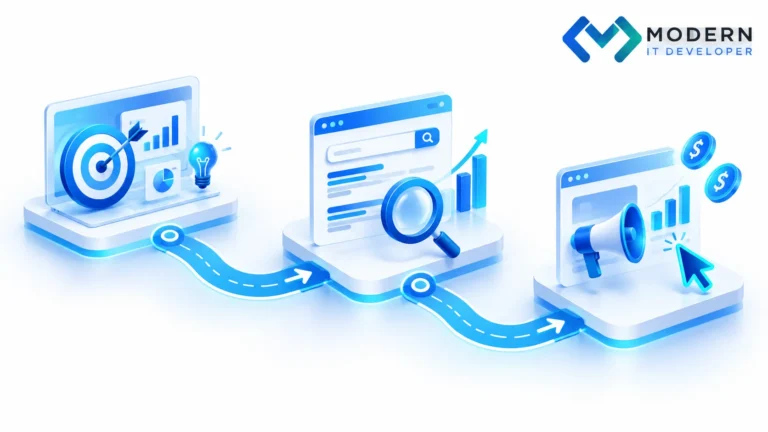
YouTube contains thousands of marketing tutorials, but jumping randomly between videos often creates knowledge gaps. A better approach is to learn three connected disciplines in the right order: digital marketing fundamentals, search engine optimization, and paid advertising.
Can You Really Learn Digital Marketing for Free?
Free courses can teach you the fundamentals required to start experimenting with digital marketing, particularly when the training comes from established education providers, marketing platforms, or experienced practitioners.
However, watching videos alone is not enough. Digital marketing becomes a real skill when you apply what you learn to websites, keyword research projects, advertising campaigns, analytics data, content strategies, and real business problems.
The 3 Courses at a Glance
| Learning Area | Recommended Resource | Best For | Main Focus |
|---|---|---|---|
| Digital Marketing | Simplilearn | Complete beginners | Marketing channels, strategy, SEO, ads, social media and AI |
| SEO | Ahrefs | Beginners and website owners | Keywords, search intent, on-page SEO, links and technical SEO |
| Paid Advertising | Surfside PPC | Beginners learning PPC | Google Ads, tracking, targeting, bidding and campaign optimization |
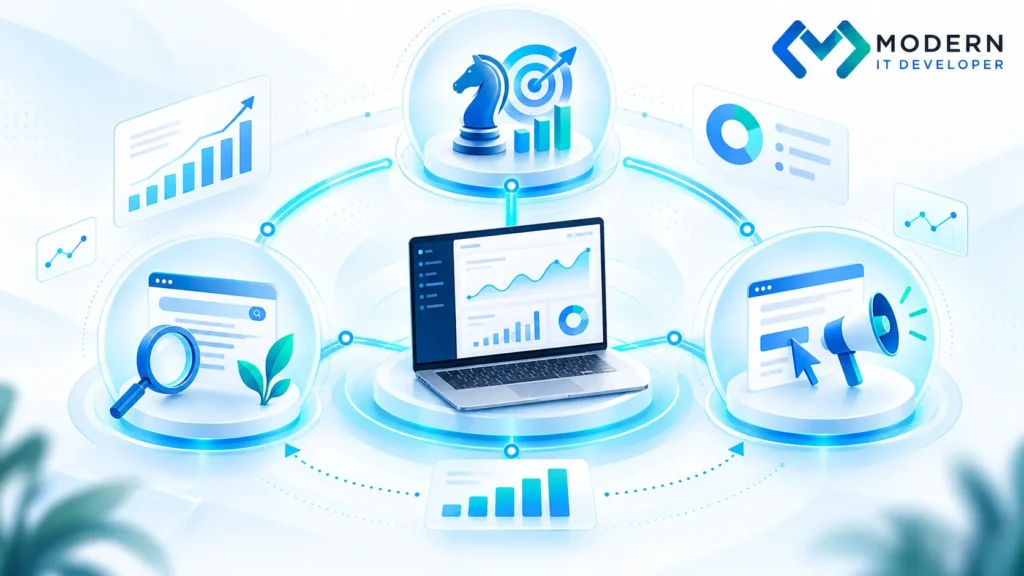
Together, these resources cover the three layers beginners usually need: understanding the overall marketing ecosystem, generating organic traffic, and acquiring customers through paid campaigns.
1. Learn Digital Marketing with Simplilearn
Simplilearn offers a broad digital marketing course covering fundamentals, Google Ads, SEO, social media, strategy, website creation, and AI-assisted marketing before specialization.
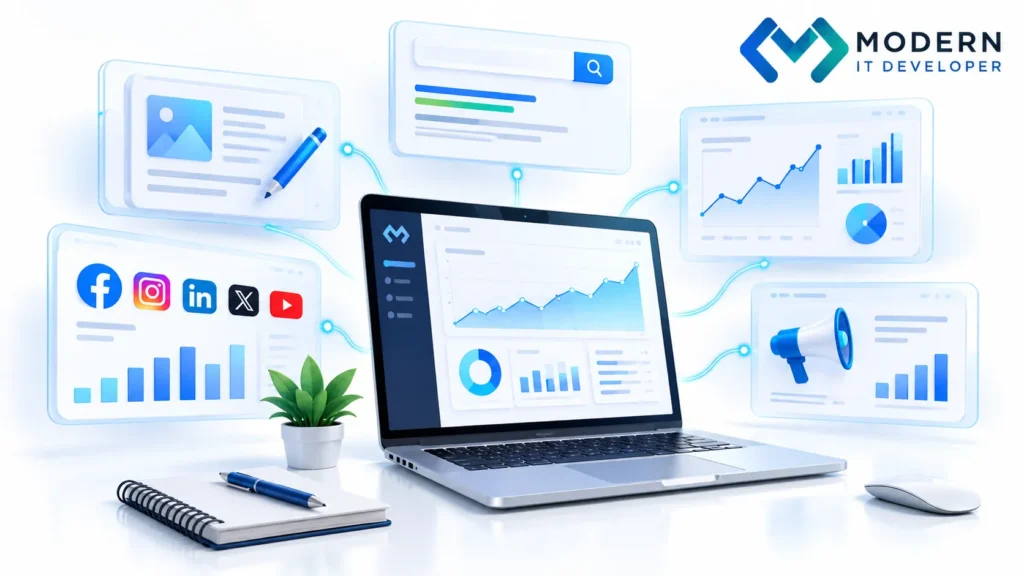
This overview demonstrates to beginners how channels are interconnected, illustrating SEO, social media, advertising, content, and analytics as integral components of a cohesive customer acquisition system rather than isolated activities.
Start here if terms such as PPC, conversion rate, search intent, retargeting, SEO, or marketing funnel are still unfamiliar.
2. Learn SEO with Ahrefs
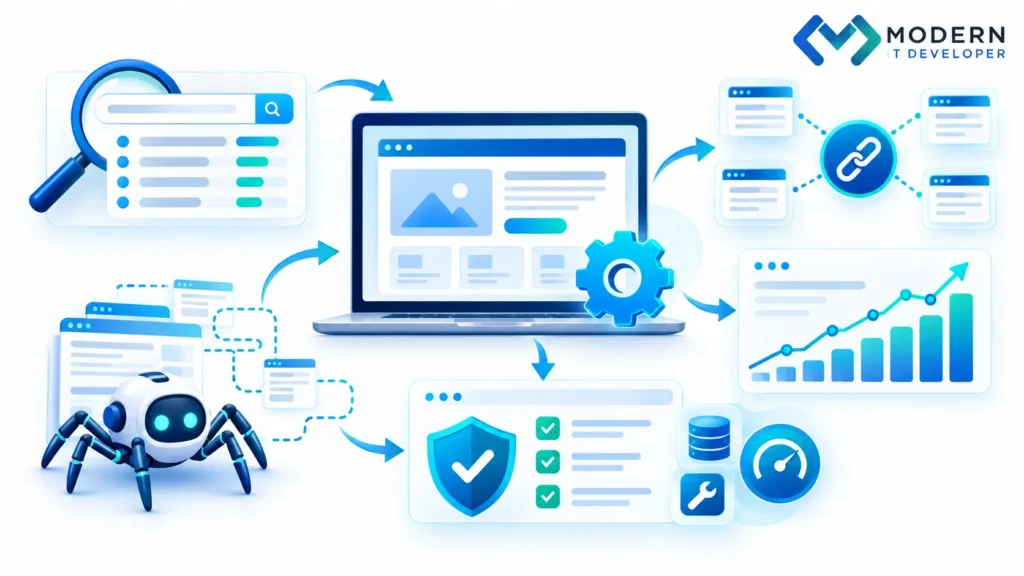
After learning basic digital marketing, SEO is a logical next step. Ahrefs offers a free, registration-free SEO beginner course on keyword research, on-page SEO, link building, search intent, ranking difficulty, and technical SEO. It includes 14 lessons in five modules and takes about two hours.
Moreover, one of the biggest advantages of this course is its practical structure. Instead of explaining SEO only as theory, it connects topics such as keywords, search intent, page optimization, backlinks, and technical issues to actual search visibility.
Google’s own documentation similarly emphasizes helping search engines understand content while helping users discover useful pages, which makes user-focused optimization an essential SEO principle.
3. Learn Paid Advertising with Surfside PPC
SEO can produce long-term organic visibility, while paid advertising helps businesses reach potential customers immediately. Surfside PPC is particularly useful for learning practical Google Ads workflows and campaign management.
Its recent Google Ads training covers conversion tracking, keyword research, bidding, campaign budgets, responsive search ads, landing pages, campaign structure, A/B testing, and moving toward automated bidding once useful conversion data exists.
One lesson is especially important for beginners: do not evaluate PPC campaigns only by clicks. Google itself recommends conversion measurement because it connects ad interactions with valuable actions such as purchases, leads, sign-ups, or calls.
As a result, this mindset separates simply running ads from managing advertising as a measurable business channel.
Why These Three Skills Work Better Together
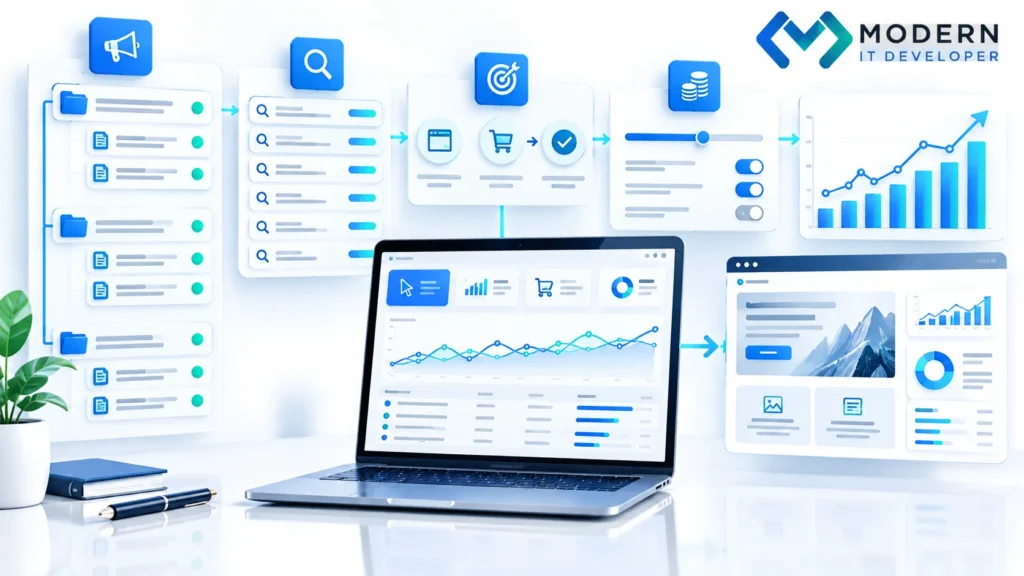
In the beginning, digital marketing gives you the strategy. SEO teaches you how people search and how to build sustainable organic visibility. Paid advertising teaches you how to buy targeted traffic and measure whether that traffic produces business results.
For example, keyword research can reveal topics for SEO content while also identifying commercial search terms for Google Ads. PPC data can reveal which offers convert, and those insights can then influence landing pages and organic content.
Therefore, learning all three areas gives you a much stronger understanding of the entire customer journey.
The Best Order to Learn Digital Marketing
Step 1: Understand the Marketing Fundamentals
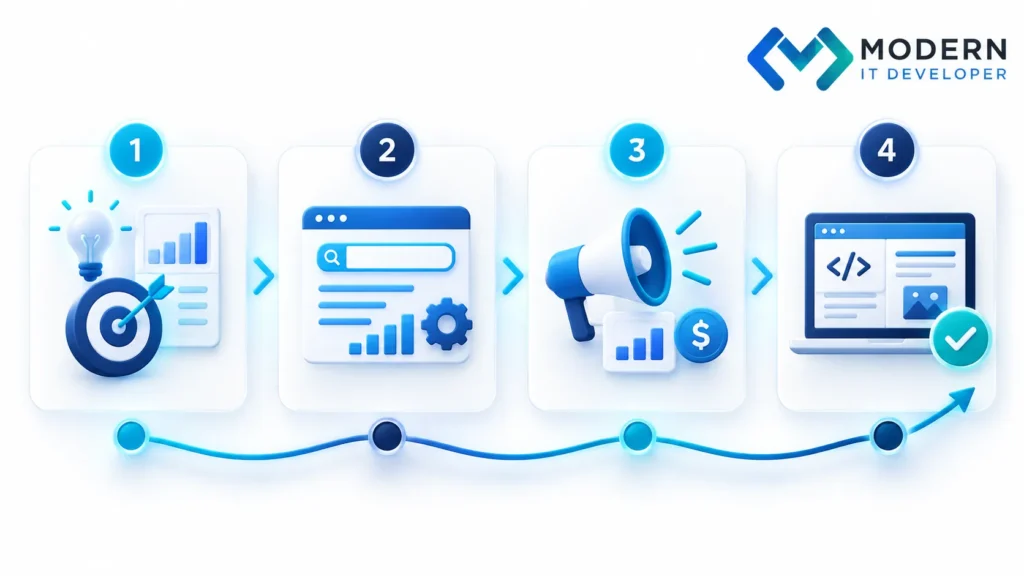
Start with Simplilearn and focus on channels, customer journeys, marketing objectives, analytics, content, and how paid and organic strategies fit together.
Do not try to memorize every platform. Your first objective is understanding why businesses use each marketing channel.
Step 2: Build SEO Skills
Move to the Ahrefs SEO course and practice keyword research, search intent analysis, on-page optimization, internal linking, backlink research, and basic technical SEO.
Choose a real website or create a small practice site so that every lesson becomes an actual task instead of another piece of theory.
Step 3: Learn Paid Advertising
Next, study Google Ads with Surfside PPC. Pay particular attention to conversion tracking, campaign structure, targeting, keywords, bidding, landing pages, and budget management.
Avoid spending significant money while learning. Practice account structure and campaign planning first, then test carefully with controlled budgets.
Step 4: Apply Everything to a Real Project
Create a small project that combines all three disciplines.
For example, build a simple website for a service, do keyword research, publish optimized landing pages, create supporting content, set up analytics, and plan a small Google Ads campaign.
This project can eventually become more valuable for your portfolio than multiple completed course certificates.
How to Turn Free Courses Into Real Marketing Skills
Use a simple 30% learning and 70% implementation approach.
Learn keyword research, then conduct it. Study Google Ads to create a campaign structure. Understand landing page optimization to audit a landing page. After studying analytics, identify real conversion events.
Also document what you do. Keep screenshots, keyword research files, SEO audits, campaign structures, traffic changes, and conversion improvements.
That documentation gradually becomes evidence of your capabilities and can support job applications, freelance proposals, client presentations, or your own business.
What Should You Learn After These Courses?
Once you understand digital marketing, SEO, and paid advertising, expand into analytics, conversion rate optimization, content marketing, email marketing, AI-assisted workflows, and website optimization.
You should also become comfortable with tools such as Google Analytics, Google Search Console, Google Ads, keyword research platforms, crawling software, and basic website management.
The goal is not to know every marketing tool. It is to understand how to choose the right channel, attract the right audience, measure performance, and improve results.

Start Learning Digital Marketing Today
You can build a strong digital marketing foundation without immediately investing in expensive training.
Start with Simplilearn for the big picture, use Ahrefs to understand organic search, and study Surfside PPC to develop paid advertising skills. Most importantly, apply each lesson to a real project as soon as you learn it.
Once the fundamentals are clear, explore more SEO, website optimization, AI marketing, and digital growth resources to continue turning knowledge into measurable business results.
FAQ Section
What is the best free digital marketing course on YouTube for beginners?
Simplilearn is a useful option for beginners because its long-form digital marketing training introduces several major areas, including SEO, paid advertising, social media, keyword research, strategy, and AI-assisted marketing. Beginners can use it to understand the overall digital marketing ecosystem before choosing a specialization.
Can I learn digital marketing completely from YouTube?
You can learn most fundamental concepts through free YouTube training, but practical experience is essential. Build websites, perform keyword research, create campaign plans, analyze performance data, and work on real or simulated projects alongside your learning.
Is the Ahrefs SEO course free?
Yes. Ahrefs currently offers its SEO Course for Beginners free of charge and without requiring registration. The course includes 14 lessons covering keyword research, on-page SEO, link building, and technical SEO.
Is Surfside PPC good for learning Google Ads?
Surfside PPC provides practical Google Ads tutorials covering areas such as campaign setup, conversion tracking, keyword research, bidding, budgets, responsive search ads, landing pages, and optimization. Its hands-on approach can be useful for learners who already understand basic marketing concepts.
Should I learn SEO or Google Ads first?
For most beginners, learning SEO fundamentals first helps develop an understanding of keywords, search intent, landing pages, and how people use search engines. Google Ads becomes easier to understand once these concepts are familiar.
How long does it take to learn digital marketing?
You can understand the fundamentals within several weeks, but professional competence requires ongoing practice. SEO, advertising platforms, analytics systems, AI tools, and search behavior continually evolve, so digital marketing involves continuous learning.
Do I need money to practice digital marketing?
Not necessarily. You can practice keyword research, content creation, SEO audits, website optimization, campaign planning, analytics concepts, and landing page design without significant spending. Paid advertising eventually requires a testing budget, but campaign structure can be learned beforehand.
What should I learn after digital marketing basics?
Focus next on analytics, conversion tracking, technical SEO, content strategy, conversion rate optimization, landing pages, email marketing, and AI-assisted marketing workflows. These skills help connect traffic generation with measurable business outcomes.